

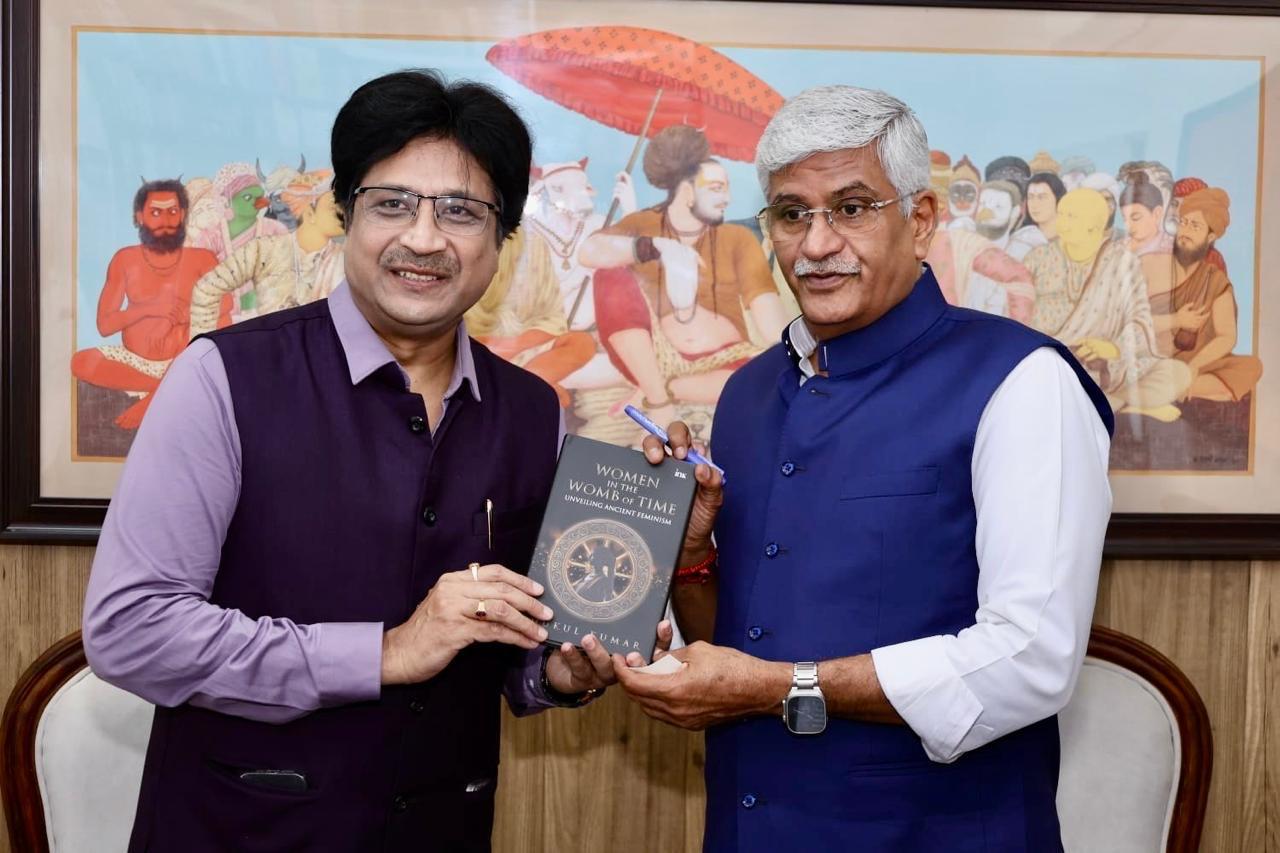
At a time when feminism is often viewed through borrowed intellectual frameworks, Women in the Womb of Time (WITWOT) by Mukul Kumar offers a refreshing and deeply rooted perspective. The book seeks to rediscover feminism within the rich and layered traditions of ancient India, moving beyond the binaries of contemporary ideological debates.
The work begins with a thought-provoking question: Why feminism and not masculinism? This inquiry serves as the foundation for an engaging exploration of the origins, evolution, distortions, and possibilities of gender discourse across different historical periods.
Rather than focusing solely on the historical subjugation of women, the book examines the complex relationship between power, agency, and identity that shaped women’s lives in ancient Indian society. Drawing from a wide range of primary sources—including the Vedas, Upanishads, Epics, Manusmriti, Arthashastra, Kamasutra, and Dharmashastras—the author reconstructs a nuanced narrative in which women emerge not merely as subjects of patriarchal structures but also as active contributors to intellectual, cultural, economic, and spiritual life.
The opening chapter establishes the book’s philosophical foundation by redefining feminism as more than a political or legal struggle for equality. Instead, it presents feminism as a broader human quest for dignity, self-realization, and wholeness. The author traces gender inequality to deeper historical and evolutionary processes, exploring how biological roles, divisions of labor, and material conditions gradually contributed to the emergence of patriarchal systems.
By engaging with influential thinkers such as Karl Marx, Simone de Beauvoir, and Judith Butler, Kumar develops a compelling theoretical framework while remaining firmly grounded in the Indian historical context. This balance between global feminist thought and indigenous traditions is one of the book’s key strengths.
What truly distinguishes Women in the Womb of Time is its refusal to romanticize the past. The author presents a balanced assessment that acknowledges both the respect accorded to women and the restrictions imposed upon them across different periods of Indian history. The Vedic age, often celebrated for its relatively egalitarian social structure, is examined alongside later texts such as the Manusmriti, which formalized hierarchical social norms.
Similarly, works like the Arthashastra and Kamasutra are interpreted not merely as political or erotic texts but as valuable sources that reveal women’s participation in matters of governance, economics, relationships, and personal agency.
The book also explores lesser-studied areas, including Buddhist traditions and evidence derived from inscriptions and ancient coins. These sources collectively shed light on the diverse ways women exercised influence—as scholars, household managers, political figures, and spiritual seekers. In doing so, the narrative challenges the simplistic image of women as merely the “second sex” and instead highlights the diversity of female experiences throughout history.
The significance of this work has been recognized by several eminent scholars, who have praised its ability to reimagine Indian feminism on its own terms. The book encourages readers to question established assumptions and reconsider the foundations of feminist discourse from both historical and contemporary perspectives.
Ultimately, Women in the Womb of Time is far more than a historical study. It is an invitation to reclaim forgotten voices and rediscover indigenous intellectual traditions. By delving into the “womb of time,” Mukul Kumar uncovers stories that have long remained unheard and weaves them into a powerful narrative of empowerment, resilience, and self-discovery.
Bridging the past and the present, the book presents a vision of feminism that is both rooted in history and relevant to contemporary society—a vision that draws strength from India’s civilizational heritage while contributing to the creation of a more inclusive future.
Author: Mukul Kumar